
ESG Reporting Frameworks: The Backbone of Corporate Transparency
A structured ESG reporting framework helps organizations disclose consistent, measurable, and comparable sustainability data. Transparent reporting allows stakeholders to evaluate a company’s environmental, social, and governance performance objectively.
According to the World Economic Forum, over 80% of global investors now consider ESG metrics before making investment decisions. This growing demand for credible data has led to the adoption of globally recognized ESG standards.
Comparing Popular ESG Reporting Frameworks
Here are the most widely used frameworks in corporate ESG disclosure:
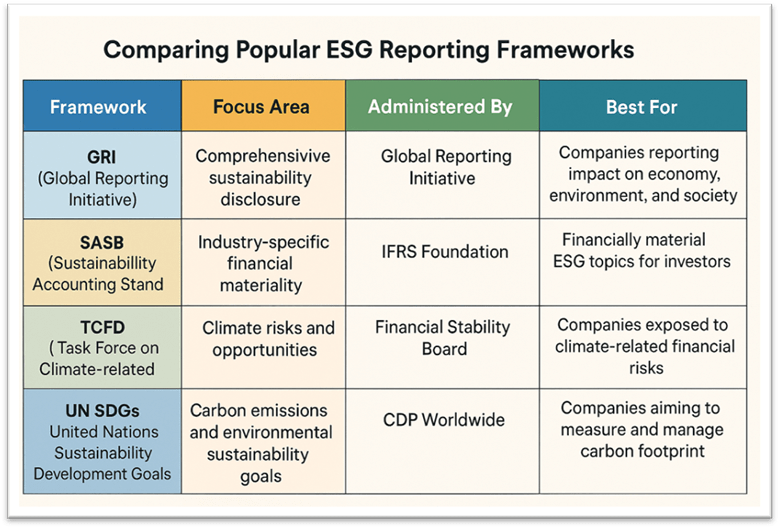
Each framework offers unique strengths. For example, TCFD is best for financial risk disclosure, while GRI provides a comprehensive overview suitable for sustainability reporting to all stakeholders.
Integrating Frameworks into Corporate Sustainability Strategy
Successful integration involves aligning internal policies with the selected frameworks. Companies can use a hybrid approach, such as combining SASB for investor reporting with GRI for public sustainability disclosures. Regular audits, third-party verification, and stakeholder engagement help maintain credibility and ensure compliance with international standards.
Challenges in ESG Integration and Reporting
While ESG adoption has accelerated, several challenges remain.
Data Inconsistency: Many firms lack standardized methods for collecting and analyzing ESG data. This leads to difficulties in comparing performance across industries.
Regulatory Diversity: Global variations in ESG regulations make cross-border reporting complex. The European Union’s Corporate Sustainability Reporting Directive (CSRD), for example, has different disclosure requirements than U.S. SEC proposals.
Resource Constraints: Small and mid-sized enterprises often face budget and skill limitations that hinder effective ESG implementation.
Greenwashing Risks: Companies that exaggerate sustainability claims without verifiable evidence can face reputational damage and regulatory penalties.
Overcoming ESG Data and Reporting Barriers
To overcome these challenges, organizations should:
- Adopt automated ESG data management systems to improve accuracy and reduce manual errors.
- Conduct third-party assurance audits to validate ESG reports.
- Train internal teams in sustainability accounting and data governance.
- Align with evolving regulations, such as ISSB (International Sustainability Standards Board) guidelines, which aim to unify global ESG disclosure practices.
Case Studies: Companies Excelling in ESG Integration
Unilever: Leading with Sustainable Business Models
Unilever’s Sustainable Living Plan, launched in 2010, integrates ESG principles into its entire value chain. The company has achieved a 52% reduction in operational emissions since 2008 and sources 68% of its agricultural raw materials sustainably (as reported in Unilever’s 2023 sustainability report). This commitment has strengthened brand trust and long-term financial stability.
Microsoft: ESG-Driven Innovation and Governance
Microsoft has pledged to become carbon negative by 2030 and remove its historical emissions by 2050. The company’s transparent ESG reporting, aligned with TCFD and GRI standards, has enhanced investor confidence. Microsoft also links executive compensation to sustainability targets, a strong example of integrating ESG into corporate governance.
The Future of ESG Integration in Corporate Strategy
Digital Transformation and ESG Analytics
Advancements in technology are transforming how organizations manage ESG data. Artificial intelligence and machine learning tools now help predict sustainability risks and track carbon performance in real time. Platforms like SpheraCloud and Datamaran are leading examples of ESG analytics tools that help businesses align with global reporting frameworks.
Regulatory Momentum and Global ESG Standards
Regulatory bodies are moving toward mandatory ESG disclosures.
- The European Union’s CSRD will require approximately 50,000 companies to publish detailed sustainability reports by 2026.
- The SEC in the United States is finalizing rules for climate-related disclosures for publicly traded companies.
- The ISSB, launched by the IFRS Foundation, is standardizing ESG reporting globally to ensure consistent and comparable data.
These developments signal that ESG integration will soon become a core requirement for corporate governance and investor relations.
FAQs on ESG Integration, Reporting, and Sustainability Strategy
- What is ESG integration?
ESG integration is the process of incorporating environmental, social, and governance factors into business strategy, risk management, and decision-making to improve long-term performance and sustainability. - How is ESG integration different from CSR?
CSR focuses on voluntary initiatives that benefit society, while ESG integration uses measurable metrics to evaluate a company’s sustainability impact and financial risk exposure. - Which ESG reporting framework is most widely used?
The Global Reporting Initiative (GRI) is currently the most widely used framework for sustainability disclosures, adopted by over 80% of the world’s largest corporations. - How does ESG impact corporate performance?
Companies with strong ESG practices often enjoy lower capital costs, improved operational efficiency, higher employee satisfaction, and stronger brand reputation. - What are the biggest challenges in ESG implementation?
Common challenges include inconsistent data collection, lack of standardization, limited internal expertise, and regulatory complexity. - How can small businesses start with ESG integration?
Small businesses can begin by setting achievable sustainability goals, using simplified frameworks such as GRI Standards for SMEs, and gradually expanding their data reporting capabilities.
Conclusion: Building a Responsible Future Through ESG Integration
ESG integration has become essential for companies that aim to build resilience, trust, and long-term value. It bridges corporate social responsibility with financial performance, ensuring that ethical behavior and environmental stewardship become part of core business operations.
Organizations that embrace credible ESG reporting frameworks, implement robust sustainability strategies, and maintain transparency will not only meet regulatory expectations but also thrive in an increasingly purpose-driven economy.